



This post was originally published on this site.
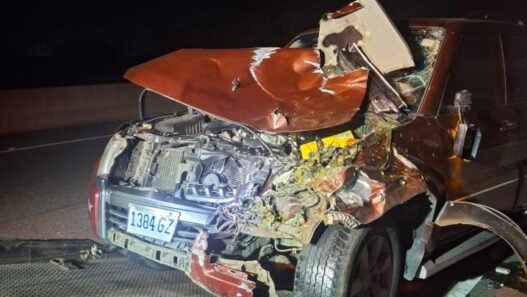
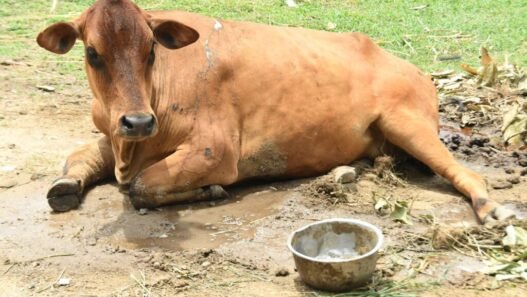
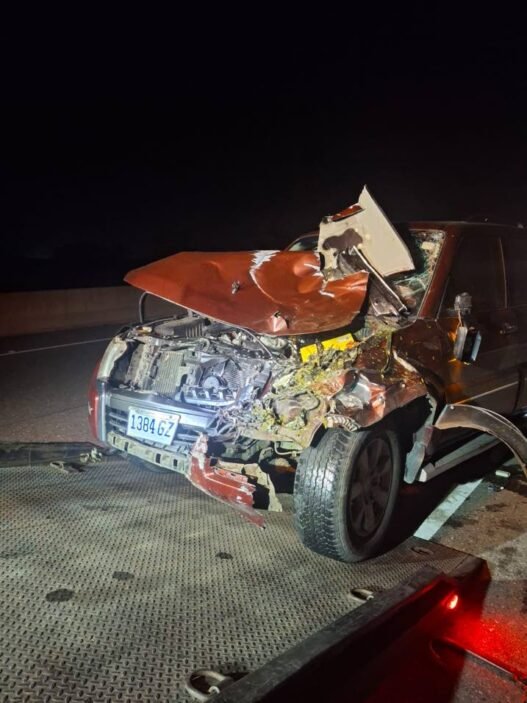
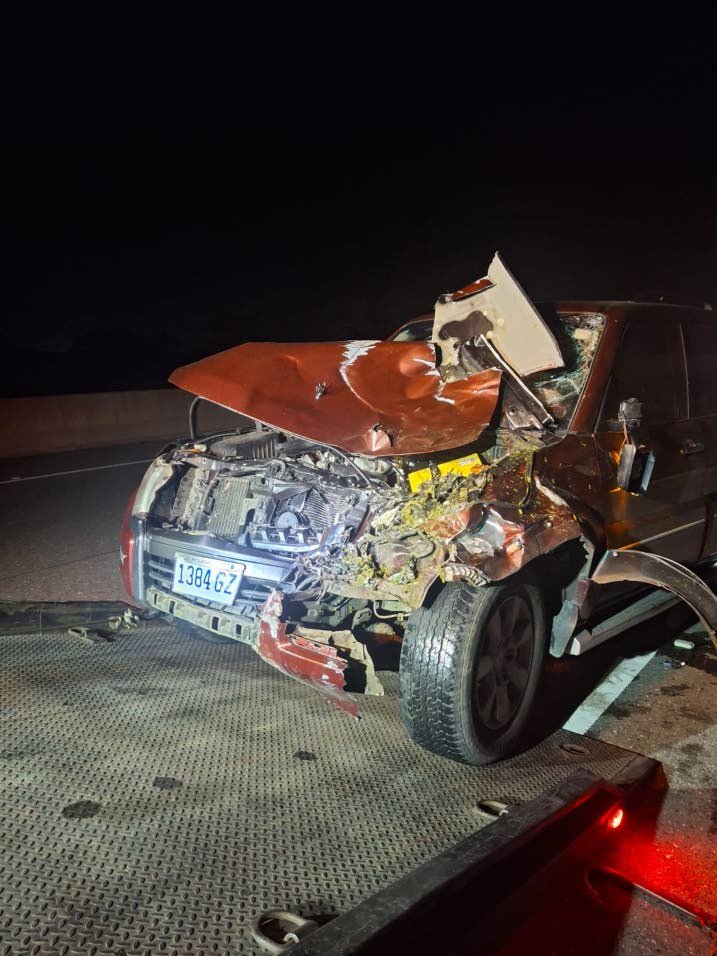
TOLL GATE, Clarendon — A night of T20 cricket enjoyment at Sabina Park in Kingston just over a week ago almost ended in death for three people when the sport utility vehicle in which they were travelling back to Mandeville crashed into a cow that had wandered onto the May Pen to Williamsfield leg of Highway 2000 in pitch darkness.
Hopeton McCatty, the driver and owner of the Mitsubishi Pajero; his friend Wensworth Skeffery, a former Opposition senator; and Skeffery’s 24-year-old daughter were not injured, but the cow died in the August 15 collision that revived fears of the danger posed to life by stray animals on the high-speed road.
“We took my friend’s daughter to cricket for the first time and she enjoyed it; a very good game of cricket, a fantastic crowd. We left Sabina Park and went downtown then joined the toll road at Portmore,” McCatty told the Jamaica Observer.
“We were talking about the experience of interacting with people and how to be humble. We were cruising along. We came through the tolls at Portmore, Vineyards, and May Pen. We were approaching the last one at Toll Gate driving at about 103 kilometres per hour… I had on the high beam, because the road was dark. We were in the left lane and while talking Skeffery said ‘Cow!’ ” McCatty related.
“I spotted this animal coming onto the road, so I braked and swerved to the right and we really thought we had missed it, but the cow kept coming and we hit the cow. The two airbags [deployed] and I swerved back to the left to avoid the median in the road. I wasn’t even able to see what was in front of me and I stopped,” added McCatty.
On Saturday, TransJamaican Highway (TJH) Limited Chief Executive Officer Ivan Anderson told the Sunday Observer that he had received a report on the incident and raised concern about residents living along that section of the highway repeatedly cutting through the fencing to get to their homes after disembarking buses travelling along the highway.
“The fence in this location has been cut and repaired several times since the start of the year. Since the initial cutting we doubled the fencing in this location by adding hog wire to the barbed wire; it is being cut by persons coming off buses on the highway and going into the community,” Anderson said in a WhatsApp response.
He said TJH is now in the process of identifying the owner of the cow as the animal was tagged.
On September 13 last year a woman had to be rushed to hospital after cattle strayed onto the highway shortly after midnight, causing extensive damage to two vehicles, a Toyota Axio and a Toyota Tacoma, and injuring occupants.
At that time the highway was toll-free. But when TJH commenced charging on December 27, 2025 it assured motorists of a First-World roadway supported by 24-hour patrols and consistent maintenance.
“Our commitment is to deliver a safe, reliable, and efficient driving experience across this new section in a manner that is consistent with our offerings on all legs of the TransJam Highway’s network. In order to deliver these services sustainably, we will introduce a toll rate structure at both the Toll Gate-MainLine Toll Plaza and the Toll Gate-Ramp Toll Plaza,” TJH said in an Instagram post.
However, for McCatty, the issue of stray cattle was compounded by him not seeing any patrols near midnight, and for close to an hour after the collision.
“The scary part about it is that when the car hit the cow all the lights went, because the battery got dislodged completely. We were out there on the highway in complete darkness,” he said.
“I didn’t know if a truck was going to come and run straight into us; and there has been an incident before on the highway network where people died after having an accident and then an oncoming vehicle hit them,” he added.
He said he was relieved when a tow truck, en route to Mandeville, stopped at the accident scene and subsequently removed his vehicle.
“God is good, because a wrecker was passing and stopped and had on its hazard lights; that give us some sense of calm that people wouldn’t run up into us in the darkness,” he said.
“The car bonnet seemed to have cut the cow’s neck. It took us about an hour to get off the road. During that time other vehicles stopped, but we didn’t see anybody from the toll [company] patrolling,” added McCatty.
He said he returned to Clarendon the Sunday afternoon following the accident to report it.
“We filed a report at the Four Paths Police Station on Sunday afternoon, because Sunday morning I couldn’t miss church. I had to give God thanks. We came out with no wounds. I reported the accident to the insurance company and the vehicle is basically written off,” he explained.
Vice chairman of the National Road Safety Council Dr Lucien Jones said he previously engaged the National Road Operating and Constructing Company (NROCC) — which is responsible for overseeing the design, construction, and maintenance of Jamaica’s highways — about the danger of stray animals on the high-speed road.
“Having a stray animal on a road which provides for driving at a fairly high speed to enable people to get from point A to point B in a fairly short time and therefore aid in the whole transportation sector carrying goods and people across the country, poses a severe problem,” he said.
“We have had this issue before. We have had discussions about it with operators of the highway [and] NROCC. We have had remedial things done on the highway, because the primary problem, as I understand it, has to do with people breaking or stealing the wires [fencing] on the highway and thus allowing cows to enter into a guarded space,” added Jones.
He is calling for the municipal corporations across Jamaica to reinstitute animal pounds and remove stray animals from endangering road users.
“We have had discussions about the role of the owners and now to hear that there was a crash recently involving a cow and a vehicle, thank God nobody died. It again raises the issue of how well we are guarding the space across the country on the highways. Not only the East-West or the North-South, but the one going from May Pen up into Mandeville. It raises an important issue which was addressed recently in an Observer editorial,” Dr Jones said.
He argued that the municipal authorities have “a mandate to provide for and enable the leading of stray cattle into pounds and to prevent individuals from allowing this kind of very dangerous situation to continue”.
Jones pointed to statistics indicating that 214 people have died on the nation’s roads since the start of the year, compared to 242 for the corresponding period last year.
“I would once again appeal to those who are so empowered — the municipal authorities and NROCC — to make sure, either separately or jointly, that our highways are made free of any kind of animal straying onto the road,” he said.
Dr Jones also pointed to another worrying trend of motorists driving the wrong way on highways.
On August 13 Parton Buchanan, a 56-year-old resident of Blenheim district in Hanover, died in a crash after he reportedly drove the wrong way onto the Porus off-ramp section of the highway near Williamsfield.
“In those instances where people have gone off-ramp in the wrong direction, they did so to either escape paying the toll or they are not aware of [how to use] that particular part of the highway. [It] requires an increase in public education as to how in certain areas we use the highways and to get people to be aware of the dangers,” said Jones.
McCatty is hoping that another layer of safety will be added by illuminating sections of the highway.
“When you have no light out there it is completely dark. If we can have lights where the toll booths are, why can’t we have it along the toll road? I am not saying you should have lights three feet apart, but there should be more light on the road,” he said.