
This post was originally published on this site.
By Dr Giselle Lawrence-Garcia
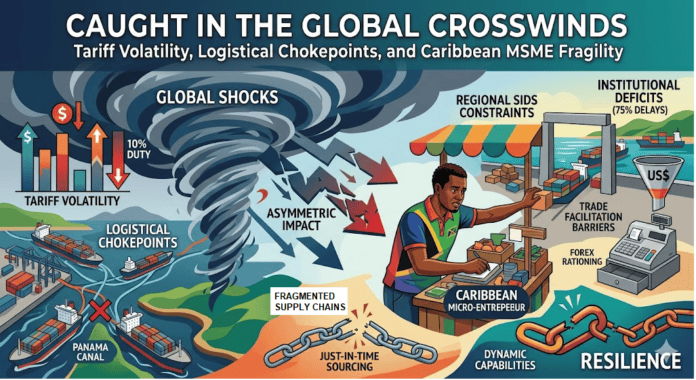
Micro, Small, and Medium Enterprises (MSMEs) form the backbone of regional economies, accounting for approximately 70 to 85 percent of all commercial firms and contributing up to 70 percent of regional Gross Domestic Product. Yet, because our island nations rely so heavily on imports and have a narrow mix of products to sell abroad, global shocks translate instantly into severe survival crises for local shops.
Today, MSMEs are caught in a high-stakes game of global shipping dominoes. To understand how they navigate this instability, business experts point to two main concepts: a company’s baseline resources and its real-world agility. While large distributors have deep pockets, financial backing, and dedicated legal teams to absorb international shocks, micro-enterprises operate with severe limitations in financing, specialised staff, and physical space. Consequently, survival relies entirely on their day-to-day agility – their speed of decision-making, hustle, and community networks to navigate a volatile business environment.
The triple threat gripping Caribbean logistics
- The survival of MSMEs is currently being tested by three structural forces:
The heavy burden of freight costs
Small island nations naturally face high exposure to economic shocks due to their open markets and geographic remoteness. Within the Caribbean, this shows up as extreme shipping cost inflation. Freight and transportation costs regularly consume a staggering 20 to 35 percent of a product’s final shelf value – much higher than the 10 percent global average. This massive gap is driven by shipping imbalances. Because Caribbean economies primarily buy manufactured goods and export very little physical cargo back out, ships travel inbound fully loaded but return north largely empty. This “empty return leg” forces ocean carriers to price inbound voyages aggressively, creating high freight bills that easily crush small, less-than-container-load (LCL) shipments.
The collapse of “Just-in-Time” ordering
Global trade policy has entered a period of intense volatility. Constant adjustments to international import rules and shifting tax rates create an unpredictable landscape for small business owners. When international factories and material costs rise, small businesses face immediate pressure. They lack the extra cash reserves needed to switch from ordering small batches as needed to buying larger safety stockpiles. Unable to buy in bulk to freeze their costs ahead of shipping surges or tax hikes; they must either absorb the loss or pass the higher prices directly onto local consumers, hurting their sales.
Bureaucratic delays at the border
Running a smooth business relies heavily on visibility, the ability to track your cargo and paperwork seamlessly across borders. While physical port space is a challenge, data shows that 75 percent of cross-border shipping delays in the Caribbean are caused by poor trade processes and administrative red tape, rather than port capacity limits. The rollout of international trade modernisation guidelines highlights this gap; Caribbean islands average a compliance rate of only 65 percent because our digital systems lag. Without a dedicated shipping department, a single customs paperwork delay can trap a small business owner’s working capital at the port for weeks, triggering devastating cash-flow crunches.
The local hurdle: The US dollar squeeze
These international logistics disruptions do not happen in a vacuum; they interact directly with our local realities. In territories like Trinidad and Tobago, supply chain delays are further worsened by ongoing foreign exchange (forex) rationing.
When global transit times double due to route closures or customs gridlocks, an MSME’s money is effectively frozen out at sea. Because local banking systems naturally prioritise massive corporate conglomerates for US dollar allocations, MSMEs face exhausting delays trying to secure the forex needed to pay overseas suppliers. This delay damages relationships with suppliers, lengthens waiting times, and hinders small firms from using modern digital shipping networks that require instant electronic payments.
What must be done: A call to action
The survival of MSMEs cannot rest solely on their personal resilience. Coordinated action is required across three critical pillars to protect our local business ecosystems:
Streamline customs and cut the red tape: Regional governments must fast-track digital customs reforms to eliminate the slow, manual processes responsible for 75 percent of shipping delays. Customs departments should also implement simplified, fast-track clearing lanes specifically for MSMEs, so their cargo doesn’t get stuck behind corporate shipments.
Fix Forex allocation for MSMEs: Central banks and commercial institutions must reform how US dollars are rationed. A dedicated, protected percentage of monthly US dollar allocations should be set aside exclusively for verified MSMEs to ensure they can pay international suppliers without months of delays.
Encourage co-shipping and regional sourcing: Local business groups and chambers of commerce should officially back and sponsor shared-container (LCL) freight programs. By pooling resources, MSMEs can combat the high 20 to 35 percent shipping costs. Furthermore, business organisations should make it easier for companies to buy materials from neighbouring Caribbean countries, reducing our reliance on distant international trade routes.
* Williams, M. (2026). Charting a new course: A strategic framework for CARICOM trade restructuring and Canada CARICOM Partnership.
# CAF Development Bank of Latin America (2022). Pathways to integration: Trade facilitation, infrastructure, and global value chains.
The post Caught in the Global Crosswinds: Tariff volatility, logistical chokepoints, and Caribbean MSME fragility appeared first on Caribbean News Global.