This post was originally published on this site.
COOPER’S PEN, Trelawny — Prime Minister Dr Andrew Holness has given a commitment to “personally oversee” the relocation of residents of Cooper’s Pen whose houses were demolished during a dispute over privately owned land, saying he may have to invoke emergency powers to get the process started by December.
Residents will be provided with a relocation grant to replace belongings damaged during the eviction, but they will have to pay for the land and utilities once they are resettled. Two sites within Trelawny are being contemplated for the subdivision which will house them.
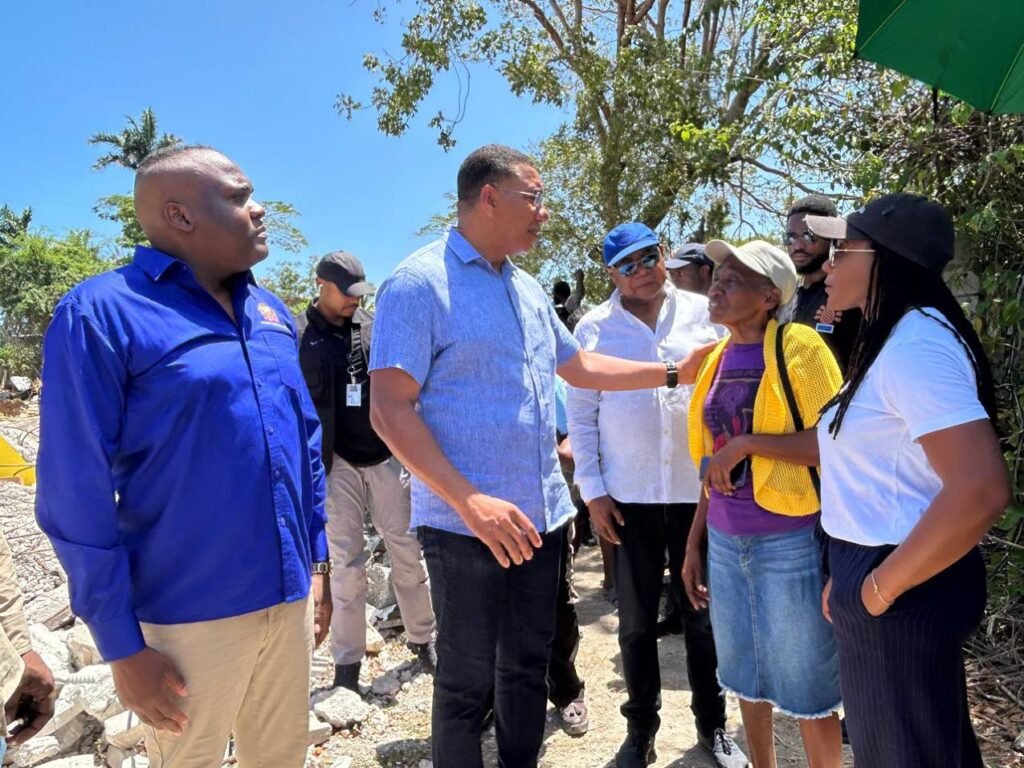
Holness — who on Friday toured the community alongside Tourism Minister Edmund Bartlett, Trelawny Northern Member of Parliament Tova Hamilton, and state minister in the Office of the Prime Minister Abka Fitz-Henley — said his intention is to move eligible residents into a properly planned community instead of shifting them from one informal settlement to another.
“My wish is that by December we could start the process of the relocation,” Holness told residents.
He cautioned, however, that the December timeline was not a firm commitment, given the number of factors involved, including the need for contractors and infrastructure works, as well as possible delays caused by weather.
“It means that I may have to use emergency powers to address some of the situation,” he said.
The prime minister also pointed out that of the two sites being contemplated, the one closer to Cooper’s Pen may not be large enough.
“I don’t believe we can accommodate all the legitimate claims that are here,” Holness said, explaining that by legitimate he meant individuals who had been acknowledged as squatters on the land before the court action and orders.
The lots will be surveyed and pegged, there will be roads, water, and electricity, and land titling will also be part of the plan.
But Holness was emphatic that the land would not be free.
Options available to residents, based on their circumstances, include long-term leases, outright purchase, and social housing arrangements for those assessed as unable to afford the cost.
Some residents who contribute to the National Housing Trust (NHT), he noted, could access their contributions to assist with acquiring the property.
For those found to have little or no means, the prime minster said there could be fully or heavily subsidised lots, with some contribution from residents through “sweat equity”.
“Government’s role is to make it affordable,” Holness said, adding that the objective was to put residents on a legitimate path to property ownership rather than perpetuate what he described as a “freeness” mentality.
He also explained the rationale behind the relocation grant.
“The Government couldn’t take up public taxpayers’ money and pay for damage caused by a private action,” he said, adding that the distinction was important to avoid setting a legal precedent that would lock the Government into being held responsible for similar circumstances in the future.
Holness framed the Cooper’s Pen saga as a pivotal moment in the country’s long-running battle with a culture of squatting.
“I see Cooper’s Pen as the watershed. This is the incident that must change Jamaica’s spatial settlement for the better,” he argued.
The prime minister said a social survey is already being conducted to determine who should benefit from the relocation programme. The Ministry of Housing has interviewed about 70 per cent of the occupants, he said, while the survey team is being augmented by the Social Development Commission along with the Ministry of Labour and Social Security.
The combined exercise, he said, will provide a clearer picture of the households, families, and vulnerable people in the community and help determine who qualifies for assistance.
Holness also warned that people who had not been living in the community before the demolition should not attempt to move in to take advantage of the Government’s response.
“I want to make it clear that anybody [who is] trying to scam the system, it won’t work!” he said.
“Bear in mind that we don’t have limitless resources, so the more people we have to accommodate, is the less you get,” he told residents.
He also reiterated that his Government does not condone or encourage squatting, adding that he has tasked Minister with Responsibility for Land Titling and Settlements Robert Montague to review the Government’s policies for dealing with squatter settlements and return with a broader proposal on regularisation and relocation.
Holness used the occasion to criticise previous administrations which, he argued, encouraged people to occupy land informally with the expectation that their status would eventually be regularised.
“The answer can’t be to acquire property illegally. The answer must be to create a process through which all Jamaicans — regardless of your colour, your class, your place of birth, your religion, your status in society — you have a fair opportunity to acquire property,” he said, adding that he was determined not to repeat those missteps.
Still, the prime minister struck a sympathetic tone with the displaced residents, saying the Government recognises the difficult circumstances in which they now find themselves.
“I don’t want any of you to feel as if the State has abandoned you. I don’t want you to feel shame, and I don’t want you to see the Government as your enemy,” he said.
“The fact is that you are also a victim of history and a victim of bad government policy… My objective is to make all of you here property owners,” he added.