






This post was originally published on this site.
WITH Jamaica and Trinidad and Tobago appearing to have moved beyond the trade tensions that once strained their commercial relationship, the twin island republic’s High Commissioner Deborah Thomas-Felix wants to build on that progress by creating stronger business connections, encouraging investment, and opening up more opportunities for companies to enter each other’s markets.
Thomas-Felix said, as Trinidad and Tobago’s high commissioner to Jamaica, her role is to identify opportunities on both sides and bring businesses and other stakeholders together, with the aim of turning both states’ improving relationship into greater commercial activity.
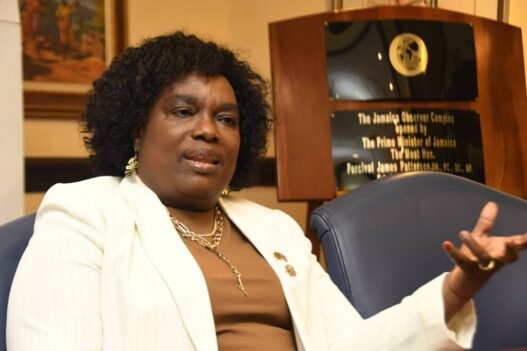
“One of the things I want is to — and I spoke to your Government about it — I want us to have more trade missions. We have a very strong relationship and I want to continue strengthening that relationship, not only in trade and culture and everything, [but] the mark that I leave should be a mark of strengthening and building the relationship that we have,” she said while speaking during a Jamaica Observer Press Club last Friday at the newspaper’s Beechwood Avenue, St Andrew, headquarters.
Her comments come against a history of difficult trade relations between the two Caribbean countries, including complaints from Jamaican exporters about access to the Trinidad and Tobago market and a significant imbalance in merchandise trade. The two countries signed a memorandum of understanding in August 2022 establishing a Trade Complaints Mechanism intended to provide a channel for resolving trade-related problems.
More recently, however, both sides have been emphasising deeper commercial ties. In July 2025, Trinidad and Tobago’s Government said increasing private sector links between the countries were helping to strengthen bilateral and intra-regional trade, while officials committed to further deepening the partnership.
Thomas-Felix said the shift is reflected in Jamaica’s growing presence in the Trinidad and Tobago market. Figures provided to her, she said, showed a substantial increase in Jamaica’s reach between 2019 and 2025.
“From 2019 — the figures from 2019 to 2025 — it seemed to show a 170 per cent increase, particularly in 2025 in terms of Jamaica’s reach into the market. So I would say that some of the issues before would not be issues now,” she said.
The diplomat said Jamaica’s changing economic profile also creates room for the relationship to evolve beyond the traditional movement of manufactured goods.
Thomas-Felix also acknowledged Jamaica’s growing strength in financial and professional services, digital and technology services, and tourism, which she noted is earning the country greater recognition in Trinidad and Tobago and other international markets.
Therefore, she wants greater emphasis placed on helping businesses identify where their strengths can complement those of companies in other countries.
“So not only in Jamaica, throughout the Caribbean and parts of the world, we supply and export manufacturing and energy products…I think that is why there would be an imbalance because, over the years, Trinidad has significantly had a very large manufacturing and energy sector,” she said.
Rather than treating the imbalance as a problem that leaves one country winning and the other losing, Thomas-Felix said both countries should be looking at how they can expand their economic footprint together.
“I don’t think we should ever look at it as one having more and one having less, but how do we help each other to be out there and be large or big in trade. And that’s the way I look at it,” she added.
The figures illustrate the scale of the challenge. Thomas-Felix said Jamaica exported approximately US$36.6 million in merchandise to Trinidad and Tobago in 2024, compared with about US$249.7 million in merchandise flowing in the opposite direction.
But she also pointed to Jamaica’s strength in services, saying the country exported approximately US$5.6 billion in services globally, against imports of about US$3.46 billion, giving it a services trade surplus of roughly US$1.8 billion. She said that strength should form part of the conversation about how Jamaica and Trinidad and Tobago can expand their commercial relationship.
That approach is already being reflected in trade missions. A Trinidad and Tobago Manufacturers’ Association trade mission to Jamaica in May 2025 was aimed at expanding market opportunities and identifying investment prospects, with the association describing Jamaica as a significant market for Trinidadian products while also encouraging Jamaican manufacturers to target the Trinidad and Tobago market.
A Jamaican trade mission to Trinidad and Tobago in September 2024 was similarly described as a step towards deepening economic ties by officials there who highlighted opportunities in food, beverages, manufacturing, and investment.
However, Thomas-Felix wants to create relationships that continue after the missions end by putting entrepreneurs, investors, and private sector organisations in contact with one another.
She also wants, when her tenure ends, to leave the bilateral relationship stronger than she found it, with trade forming only one part of a wider network of links between the two countries.
She noted that the relationship cannot be measured solely by government agreements or trade figures. Trinidadians have established lives and careers in Jamaica, while Jamaicans have done the same in Trinidad and Tobago, creating links that run through families, workplaces, education, and culture.
“So the relationship is way beyond government to government, it’s really about people, and we interact through music, we interact in terms of culture, and so I want to really strengthen those bonds and to make sure that if I can spot connections, opportunities, et cetera, that I share it with people in Trinidad and Tobago, because I’m here to advance the interests of Trinidad and Tobago and also share it to the people in Jamaica,” she said.